
In streetwear, graphics do more than decorate a garment. They help define brand identity, shape first impressions, and often determine whether a product feels standard or distinctive.
For brands developing hoodies, T-shirts, and other graphic-led pieces, puff printing is one of the most effective ways to make a design feel more intentional without moving into heavier embellishment methods like embroidery or appliqué.
This guide explains what puff printing is, how it works, where it performs best, and what brands should consider before using it in production.
What Is Puff Printing?
Puff printing is a type of screen printing that uses a special ink additive, or puff ink, designed to expand during the curing process. After printing, the garment passes through heat, which activates the ink and causes the printed area to rise.。
The finished result is a soft, elevated print surface. Depending on the artwork, ink formula, and production settings, the effect can be subtle or more pronounced.
How puff printing works
The basic process is similar to standard screen printing, but the final result depends heavily on heat activation.
A typical puff print process includes:
- preparing the artwork for screen printing
- applying puff ink or ink mixed with puff additive
- printing the design onto the garment
- curing the print under controlled temperature
- allowing the ink to expand evenly during the heating stage使
This expansion is what gives puff printing its signature raised texture. Without proper curing control, the effect can become uneven, too flat, or overly swollen.
How it differs from regular screen printing
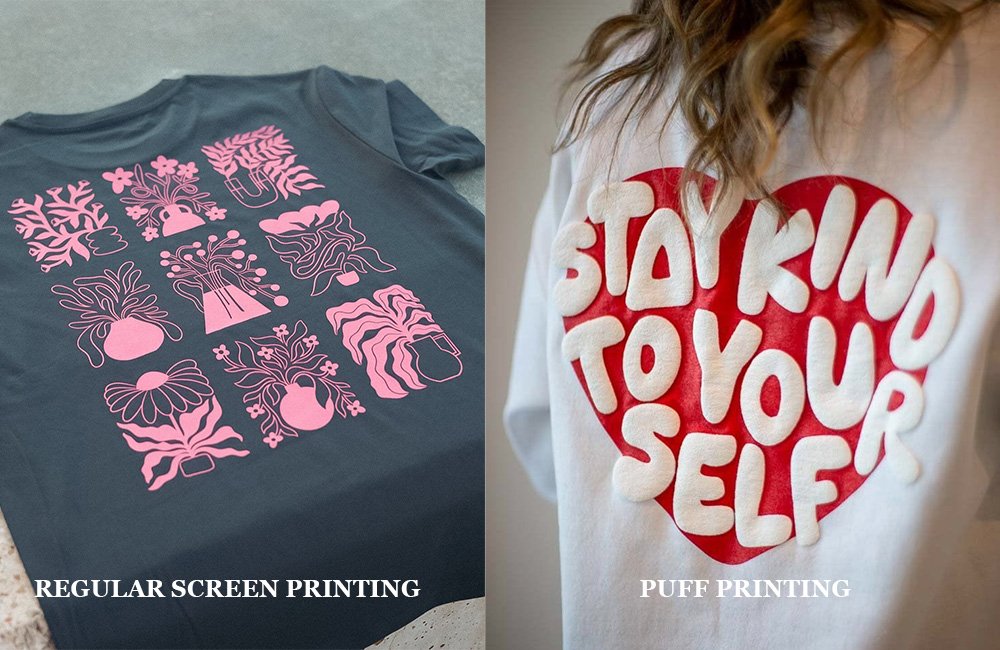
Traditional screen printing produces a flat ink layer. Puff printing changes the surface by adding height, which affects both appearance and hand feel. It also changes how the artwork catches light, making simple graphics stand out more clearly without increasing design complexity.
For that reason, puff printing is not just a production choice. It also affects how the graphic is perceived on the finished garment.
Advantages and Limitations of Puff Printing
Puff printing is widely used in streetwear because it adds more presence to graphic designs without requiring heavier decoration methods.
At the same time, It is not the right choice for every design.Understanding advantages and limitations helps brands make better development decisions.
Advantages
- Creates a raised 3D effect for graphic designs.
- Works well for bold logos, lettering, and simple artwork.
- Adds visual depth without using embroidery.
Limitations of Puff Printing
- Limited suitability for complex or intricate designs.
- Higher production costs compared to traditional screen printing.
- Longer production time due to the additional curing process.
Needs production control
The final effect is influenced by ink deposit, curing temperature, and fabric surface. If these are not handled well, the print may look uneven or unstable after washing.
What Types of Designs Work Best for Puff Printing?
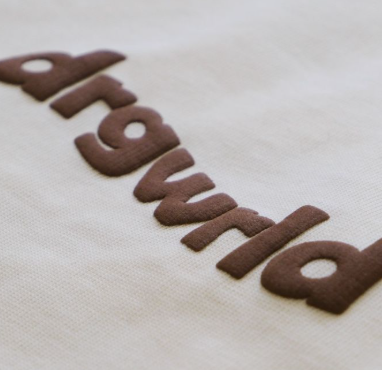
Not every graphic is a good candidate for puff printing. One of the most common development mistakes is trying to apply puff print to artwork that was originally designed for flat execution.
To get a clean result, the design needs to account for how the ink expands during curing.
Best design characteristics
Puff print usually works best with artwork that includes:
- thick lines
- bold letterforms
- simple shapes
- clear spacing between elements
- strong outlines
- limited fine detail
These characteristics give the ink enough room to expand while keeping the overall graphic readable.
Designs that often cause problems
Some graphic styles are harder to execute consistently with puff ink, especially in bulk production. These include:
- very thin lines
- small text
- intricate illustrations
- heavy shading
- gradient-based graphics
- tightly packed artwork with minimal negative space
When the ink rises, the edges naturally soften slightly. If the original artwork is too detailed, the final print can lose clarity.
What Fabrics Work Best for Puff Printing?
Fabric choice has a direct impact on print clarity, stability, and wash performance.
Cotton is usually the most reliable option
Puff printing generally performs best on cotton and cotton-rich blends. These fabrics offer a stable surface, accept print well, and are already widely used in streetwear.
Common options include:
- 100% cotton jersey
- heavyweight cotton T-shirts
- cotton-poly fleece
- brushed sweatshirting
- French terry
These materials support the print layer well and usually produce a cleaner result.
Puff Printing vs Other Decoration Methods
| Method | Best Use Case | Strengths | Limitations |
|---|---|---|---|
| Puff Printing | Bold streetwear graphics, logos, typography | Raised effect, stronger visual impact, good for heavyweight garments | Less suitable for intricate detail |
| Screen Printing | Standard graphic printing | Versatile, sharp, cost-effective | Lacks surface depth and tactile impact compared |
| Embroidery | Small logos, premium branding | Durable, textured, premium feel | Heavier and less flexible for large graphics |
| Heat Transfer | Detailed or multi-color artwork | Precise and clean | Less tactile, less dimensional |
What Brands Should Prepare Before Working With a Manufacturer
Clear preparation usually leads to better sampling and fewer revisions.
Useful materials to provide
A manufacturer can typically develop puff print more efficiently when the brand supplies:
- vector artwork
- print size references
- placement details
- target garment fabric目
- color direction
- reference images showing the desired puff effect
Not all puff prints should look the same. Some brands want a subtle lift, while others want a more pronounced result. Visual references help reduce uncertainty.
Questions worth clarifying early
Before confirming sampling or production, it is useful to ask:
- whether the artwork is suitable for puff
- whether any linework should be adjusted
- how the chosen fabric may affect the print
- whether wash testing is recommended
- whether a mixed puff-and-flat approach would produce a better result
These questions help improve execution before the order moves forward.这
Conclusion
Puff printing can be a strong option for streetwear brands that want graphics to feel more noticeable without adding unnecessary complexity. For the right designs, it offers a clean way to bring more character to T-shirts, hoodies, and other graphic-led styles.
If you are considering puff printing for an upcoming collection, contact us to discuss your ideas. Our team can help you evaluate the artwork, fabric, and print method before moving into sampling.
FAQ
Yes, it can be durable when the artwork, ink, fabric, and curing process are properly matched. Wash testing is still recommended before bulk production.
Not necessarily. When the artwork, ink, fabric, and curing process are properly matched, puff print can be durable. Cracking is more likely when the print is overstretched, poorly cured, or applied on an unsuitable fabric.
In many cases, yes. Puff printing is often more cost-effective than embroidery, especially for larger graphics. However, the final cost still depends on the design size, print placement, order quantity, and production requirements.