
Despite the rapid evolution of digital garment decoration, screen printing remains the undisputed gold standard for streetwear production. For emerging and established brands alike, understanding the nuances of this medium is critical to achieving the “premium” feel that consumers demand.
In a market where perceived value is driven by tactile quality and longevity, the technical execution of your screen prints can be the difference between a cult classic and a clearance item.
What Is Screen Printing?
Screen printing is a process in which ink is pushed through a mesh screen onto the garment. Each color usually requires its own screen, so the design is built one layer at a time.
In streetwear, this method is valued for its strong color payoff and clear graphic presence. It works especially well for logos, slogans, and statement artwork that need to read clearly from a distance or hold visual weight on a garment.
Although the process itself is straightforward, the final result depends on more than the artwork alone. Fabric surface, ink choice, print placement, and curing all influence how the graphic looks and how well it holds up over time.
Why Screen Printing Works So Well for Streetwear?
Streetwear graphics are often direct, visible, and central to the identity of the product. Screen printing suits that well because it creates a solid, confident look that feels intentional on both simple and graphic-heavy pieces.
It is also well suited to brands producing repeat styles in volume. Once the artwork and screens are set up, the method becomes efficient for larger runs, which makes it especially useful for core products and seasonal graphic programs.
For this reason, screen printing remains a standard choice not only for established labels, but also for growing brands moving from concept-level sampling into full production.
How Screen Printing Works: From Design to Garment
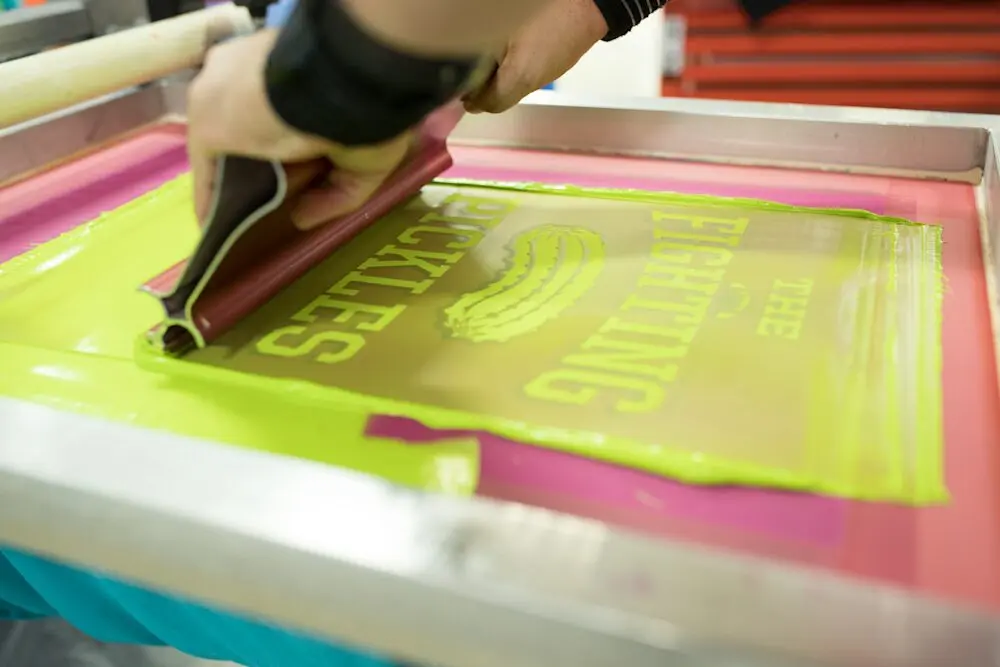
Screen printing is a stencil-based technique that involves pushing ink through a mesh screen onto a substrate. For a professional factory, the process is highly controlled:
Curing: The garment passes through a conveyor dryer at specific temperatures (usually around 160°C for plastisol) to chemically bond the ink to the fibers.
Art Preparation & Color Separation: Your digital design is broken down into individual color layers. Each color requires its own screen.
Screen Exposure: A mesh screen is coated with light-sensitive emulsion. The design is placed over it, and UV light “burns” the image into the screen, creating a stencil.
The Press Setup: The screens are mounted on an industrial carousel. Registration—the precise alignment of these screens—is critical to prevent “bleeding” or misalignment.
Ink Application: A squeegee moves across the screen, forcing ink through the open areas of the stencil onto the fabric.
Advantages and Limitations
Understanding the trade-offs of screen printing is essential for inventory planning and budget management.。
The Advantages
- Superior Durability: Screen-printed graphics can withstand dozens of heavy wash cycles without cracking or fading.
- Vibrant Color Match: We utilize the Pantone Matching System (PMS) to ensure 100% color accuracy, which is difficult to achieve with CMYK-based digital printing.
- Scale Efficiency: The “cost per unit” drops significantly as order volume increases, making it the most economical choice for “drops” of 500+ units.
- Specialty Finishes: Only screen printing allows for techniques like puff, glow-in-the-dark, and high-density textures.
The Limitations
- Minimal Order Quantities (MOQs): Most manufacturers require MOQs (e.g., 50 pieces) to offset the labor-intensive setup.
- High Initial Setup: Because each color requires a physical screen, designs with many colors have higher upfront costs.
- Complexity Restrictions: Extremely fine gradients or photographic details can be challenging compared to digital methods.
Fabric Requirements for Screen Printing
On clean fabric surfaces, the print usually looks sharper and more consistent. On more textured or uneven materials, the graphic can lose clarity, especially in solid areas or finer details.
Screen printing is commonly used on:
- 100% cotton T-shirts
- heavyweight jersey
- hoodies and sweatshirts
- French terry
- cotton-rich blends
Fabrics That Create Challenges
Textured fabrics, brushed surfaces, and high-stretch materials can make printing less predictable. Ink may sit unevenly, edges may look softer, and large prints on stretch fabrics may become more vulnerable to cracking over time.
This does not mean those fabrics cannot be printed, but they usually require more careful testing before production.
Best Use Cases in Streetwear
Screen printing is especially effective on graphic-led pieces where the print is a major part of the product. It works well on cotton T-shirts, oversized tees, hoodies, sweatshirts, and other casual staples that rely on visual identity.
Common use cases include:
- front or back statement graphics
- logo-driven streetwear basics
- drop merchandise
- text-based designs
- sleeve or secondary placements
For many brands, screen printing becomes the foundation of their graphic program because it offers a strong balance between impact and practicality.
Design Considerations Before Sampling
A design that looks good on screen does not always translate directly into production. Screen printing gives brands a lot of freedom, but it still works within certain technical limits.
Color Count Affects Cost and Complexity
Because each color usually requires its own screen, the design becomes more expensive and more complex as the number of colors increases. A simple one-color logo is relatively easy to produce. A multi-color artwork with close alignment is much more demanding.
Fine Details Need Review
Screen printing can produce clean results, but very small text, thin lines, and highly intricate details should be reviewed before sampling. In some cases, artwork needs slight adjustment to print more clearly and consistently.
Durability Depends on Execution
A well-made screen print can last very well, but poor execution leads to problems quickly. Incorrect curing, unsuitable fabric, or overly heavy ink application can all reduce long-term performance.
Cost and MOQ Considerations
From a cost perspective, screen printing makes the most sense when order volume is large enough to justify the setup. Brands should evaluate not only the unit cost, but also the number of colors, print placements, and whether the same design will be repeated across multiple pieces.
A one-color logo across a bulk hoodie order is usually efficient. A low-volume order with multiple colors across different styles is much less so.
For that reason, screen printing is often the best fit when:
- producing in moderate or large quantities
- the graphics are repeatable
- the design is visually strong without being overly complex
- the collection needs a scalable print method
Screen Printing vs. Other Decoration Methods
| Feature | Screen Printing | DTG (Direct-to-Garment) | Heat Transfer |
| Best For | Bulk production, bold logos | One-offs, complex photos | Small logos, jerseys |
| Hand-Feel | Range from soft to heavy | Very soft (water-based) | Plastic-like/Filmy |
| Durability | High | Moderate | Low to Moderate |
| Cost per unit | Decreases with volume | Static | Static |
A Practical Approach for Streetwear Brands
The most effective use of screen printing is often strategic rather than automatic. Core graphic tees, repeat hoodie styles, and logo-driven products are usually strong candidates. At the same time, some collections benefit from using other graphic methods alongside it.
A brand might use screen printing for main artwork, embroidery for smaller branding details, and digital methods for testing more complex graphics. That kind of structure gives the collection more flexibility while keeping production decisions grounded.
Conclusion
Good results depend on more than the print method itself. The artwork, fabric, placement, and production control all need to work together. When those elements are aligned, screen printing can be one of the most effective and scalable options in a streetwear collection.
If you are developing graphic streetwear and want to choose the right printing method for your products, working with an experienced manufacturer can make the process much more efficient. The right guidance helps reduce avoidable issues in sampling, improve print consistency, and prepare the collection more confidently for production.