
In the fast-evolving landscape of urban fashion, the ability to rapidly prototype and execute complex designs is a prerequisite for success. Direct-to-Garment (DTG) printing has emerged as a cornerstone technology for streetwear brands, offering a bridge between high-concept digital art and physical apparel.
As a specialized streetwear manufacturer, we’ve seen how DTG can empower independent labels to compete with industry giants through agility and precision.
The Evolution of Streetwear Graphics and DTG
Streetwear has always been a medium for storytelling. Today, that story is told through vibrant gradients, fine-lined illustrations, and high-contrast photography. Traditional methods often struggle with this level of complexity without incurring massive setup costs.
DTG functions much like an inkjet printer for textiles, spraying specialized aqueous pigment inks directly into the fibers. This allows for a level of detail that traditional screen printing simply cannot replicate, making it the go-to solution for premium streetwear manufacturing.
How It Works?
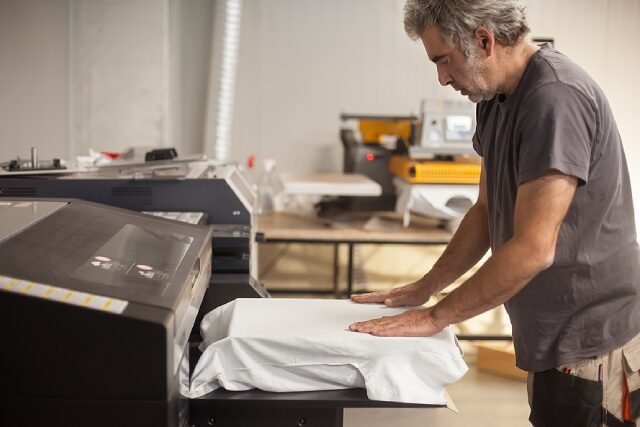
Unlike screen printing, DTG uses specialized print heads to apply aqueous pigment inks directly into the fabric’s fibers
The Process in Brief:
- Pre-treatment: A liquid solution is applied (especially on dark garments) to prevent ink absorption and ensure color vibrancy.
- Digital Translation: The artwork is processed via specialized RIP software, allowing for 1:1 reproduction of the digital file.
- Heat Curing: The printed garment is passed through a high-temperature conveyor dryer to “set” the ink, ensuring wash-fastness.
Advantages and Limitations of DTG
Understanding the trade-offs is crucial for any brand manager when selecting a production method.
The Advantages:
- Infinite Detail: Perfect for photorealistic graphics, intricate gradients, and fine lines that screen printing simply cannot capture.
- No Set-up Costs: Since there are no screens to burn, DTG is incredibly cost-effective for low-volume runs and one-off samples.
- Sustainable Production: DTG is generally more eco-friendly, using water-based inks and generating significantly less waste and water runoff than traditional dyeing/printing.
The Limitations
While DTG offers immense flexibility, it is not a “magic bullet” for every production run.
- Speed at Scale: While great for small batches, it is slower than screen printing for high-volume bulk orders (e.g., 1,000+ units).
- Fiber Dependency: DTG requires organic fibers to “bind” effectively, which limits its use on certain synthetic performance fabrics.
The Critical Factor: Best Fabric for DTG
For premium streetwear, the “canvas” is just as important as the ink. To achieve that high-end, retail-ready look, the fabric composition is non-negotiable.
- 100% Combed & Ring-spun Cotton: The gold standard. The smoother the surface, the sharper the print.
- High-GSM Heavyweights: Streetwear brands often favor 240GSM to 400GSM fabrics. At our factory, we use specialized platens to ensure these thicker materials remain stable during the printing process.
- Avoid High-Polyester Blends: Polyester repels water-based DTG inks, leading to a “muted” or “distressed” look unless specialized (and often expensive) poly-ink systems are used.
Best Use Cases for DTG in Streetwear
Complex Gradients and Portraits
If your collection features “vintage-washed” band tees or photographic portraits with subtle skin tones and shadows, DTG is the only method that will maintain the artistic integrity of the original file.
Rapid Prototyping and Market Testing
Before committing to a 500 piece bulk order, savvy brands use DTG to produce high-quality samples for photoshoots and social media “hype” testing. This data-driven approach to manufacturing reduces deadstock.
Commemorative and Limited Drops
For hyper-exclusive drops that are only available for 24 hours, DTG provides the turnaround speed and low-volume feasibility required to execute a “scarcity” marketing strategy.
Common Mistakes to Avoid with DTG
Many brands struggle with DTG quality because they overlook the technical nuances. Here are the most frequent pitfalls we see (and how we solve them):
- Neglecting the Pre-treatment “Halo”: On dark garments, improper pre-treatment application can leave a faint rectangular mark. We utilize automated pre-treatment systems to ensure an even, invisible application.
- Designing in Low Resolution: You cannot print what isn’t there. We always recommend 300 DPI files to avoid “pixelation” in the final garment.
- Inadequate Curing: If the ink isn’t cured at the exact temperature for the right duration, the print will fade after 2-3 washes. Our factory uses industrial-grade tunnel dryers rather than manual heat presses to ensure lifetime durability.
Conclusion
DTG has earned an important place in modern streetwear production because it supports the way many brands now operate: smaller runs, faster launches, more design variation, and lower inventory risk.
Not sure whether DTG, screen printing, or another method is right for your streetwear collection? Talk to our team and we’ll help you choose the most practical solution based on your design, fabric, and order quantity.
FAQ: What You Need to Know
Yes. However, the surface “fuzziness” of heavy fleece requires a specific pre-treatment press to ensure a smooth print surface.
No. Unlike heat transfers, DTG ink sinks into the fibers. After the first wash, the “hand-feel” is incredibly soft and breathable.
DTG performs best on 100% cotton or high-cotton-content garments with a smooth fabric surface.
Absolutely. We apply a high-density white under-base first, which allows the CMYK colors to remain vivid even on the darkest fabrics.
DTG is usually the better option for low MOQ orders, highly detailed graphics, quick sampling, and limited-edition drops.