
In the fast-paced world of fashion management, turning a creative sketch into a physical garment can feel like translating a foreign language. Enter the tech pack—the single most important document in the apparel manufacturing process.
Whether you are an emerging designer launching your first clothing line or an established brand looking to streamline production, understanding and creating a precise tech pack is the key to success.
What is a Tech Pack?
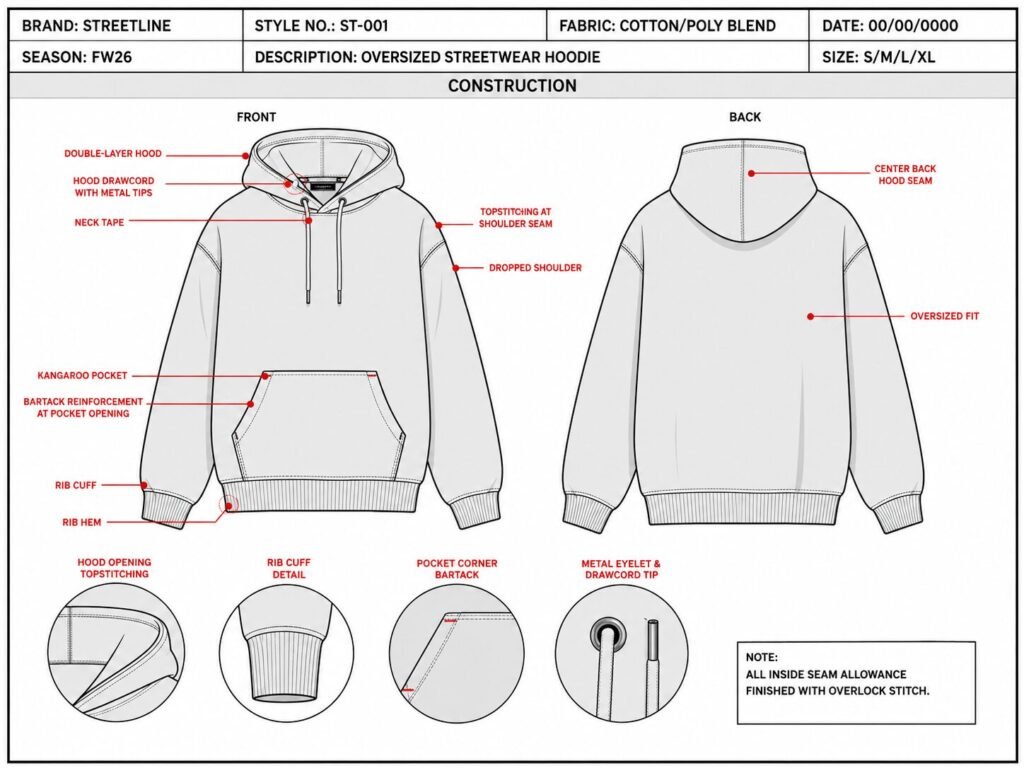
A tech pack (short for technical packet) is a comprehensive blueprint created by a fashion designer. It contains all the technical specifications and design details that a manufacturer needs to turn your concept into a mass-produced product.
Think of it as an architectural blueprint, but for clothing. It bridges the communication gap between your creative vision and the factory’s technical capabilities.
Tech Pack vs. Spec Sheet: What’s the Difference?
Many industry newcomers confuse a tech pack with a spec sheet (specification sheet).
- A spec sheet is just one component of a tech pack, focusing purely on garment measurements and size grading.
- A tech pack is the entire master file that includes the spec sheet, bill of materials, packaging instructions, and colorways.
Why Every Clothing Brand Needs a Professional Tech Pack
Skipping the technical documentation phase is the number one mistake new fashion brands make. It often results in thousands of dollars of wasted inventory. A professional tech pack serves multiple critical business functions:
- Eliminates Factory Guesswork: Factories do not have to guess your intentions. Every detail—from stitch type per inch to button placement—is clearly spelled out.
- Reduces Sample Rounds and Costs: Fewer misunderstandings mean fewer sample iterations. Reducing sample rounds from five to two can save thousands of dollars and weeks of development time.
- Acts as a Legal and Commercial Contract: If a manufacturer delivers a batch of clothing that doesn’t match the metrics listed in your tech pack, you have a solid basis for product returns or financial compensation.
- Provides Accurate Price Quotations (CMT): Manufacturers cannot give you an accurate CMT (Cut, Make, Trim) cost per unit without knowing the exact fabrics, trims, and construction complexity beforehand.
What Does a Production-Ready Tech Pack Include?
A production-ready tech pack leaves zero room for imagination. While complexity varies by garment type (e.g., activewear vs. tailored suits), a complete document must feature these seven core sections:
1. Brand & Design Overview
The introduction of your document. It includes your brand name, style number, style name, season, creation date, and a high-level summary of the garment.
2. Technical Sketches (Flats)
Detailed, 2D black-and-white drawings showing the front, back, side, and interior views of the garment.
- Callouts: Annotations pointing out specific design details like hidden zippers, bartacks, or lining structures.
3. Bill of Materials (BOM)
A master shopping list of every physical input required to create the finished product.
- Fabrics: Content weight (GSM), composition (e.g., 100% organic cotton), and supplier info.
- Trims & Findings: Zippers (e.g., YKK), buttons, elastic bands, velcro, and sewing threads.
- Labels & Tags: Care labels, size tags, brand main labels, and hangtags.
4. Size Specification Sheet & Grading
A matrix listing the exact measurements for every critical point of measure (POM) across your entire size run (e.g., XS, S, M, L, XL). It defines how the garment scales up or down based on a base size (usually size Small or Medium).
5. Colorway Options
A breakdown of the specific color combinations for the production run. This section uses standardized color codes—such as Pantone Fashion, Home + Interiors (TCX/TPG)—to ensure the dyed fabric matches your design across different lighting conditions.
6. Component Artwork (Prints, Embroidery, Graphic Placement)
If your garment features screen prints, embroidery, or custom patterns, this section provides the precise dimensions, scaling, placement measurements, and printing techniques (e.g., high-density print, puff print, plastisol).
7. Packaging & Folding Instructions
Clear guidelines on how the finished product must be folded, tagged, bagged, and boxed for shipping. This includes polybag dimensions, barcode placement, and carton labeling to comply with modern warehouse fulfillment standards.
How to Create a Tech Pack?
Building a technical packet requires precision and a systematic approach. Here is the standard industry workflow:
- Research & Source Materials: Before sketching, know your fabrics. You cannot complete a BOM without knowing the shrinkage and weight of your primary textile.
- Draft the Flat Sketches: Use software to create clean, proportional 2D drawings. Do not use fashion illustrations (croquis) with human figures; factories need flat layouts.
- Establish Points of Measure (POM): Define your key measurement points (e.g., chest width, total length, sleeve opening).
- Compile the BOM: Document every thread, label, and zipper pull.
- Set Tolerances: Define the acceptable margin of error for production. For example, a tolerance of $+/-$ 0.5 cm means the factory is within acceptable quality limits if a sleeve is half a centimeter longer than specified.
Tools Used to Create Tech Packs
Creating a tech pack requires tools for technical sketching, specifications (BOM/Measurements), and team collaboration. The industry standard involves combining design programs with cloud-based development platforms.
1. Technical Design & Illustration
- Adobe Illustrator: The undisputed industry standard for creating flat sketches, colorways, and callouts (seams, stitches, hardware placement).
- Procreate: A popular iPad app used by designers for quick sketching and initial design ideation.
- CLO 3D & Browzwear: 3D digital modeling software that lets designers drape garments, test fits, and generate virtual prototypes without physical samples.
2. Specs, Sizing & Data (The “Pack”)
- Excel / Google Sheets: Traditionally the most common method for outlining grading, measurements, and Bills of Materials (BOMs).
- Techpacker: Cloud-based software designed specifically to replace the clunky Illustrator + Excel workflow by streamlining spec sheets and allowing direct integration with Adobe Illustrator.
- Surefront: A collaborative platform offering customizable tech pack templates to automate data, images, and spec entry.
3. Product Lifecycle Management (PLM)
For larger teams and brands, centralized software manages the entire product journey from concept through to manufacturing:
- Backbone PLM (by EDITED): Manages tech packs, costs, and materials in a single collaborative source of truth.
- WFX PLM & Centric PLM: Enterprise-level software solutions that include in-depth tech pack tools, supplier databases, and vendor communication.
4. AI-Powered Generation Tools
Emerging AI solutions can now draft partial or near-complete tech packs from image uploads or basic prompts:
- AI Techpacks: Helps generate professional tech packs quickly by automating the drafting of specs and measurements.
- CALA: A design and supply chain platform featuring AI-assisted generation.
- Pietra Studio: Uses AI to generate factory-ready technical drawings and development documents.
FAQ
The cost of a professional tech pack typically ranges from $150 to $500+ per style, depending on the complexity of the garment. A basic t-shirt tech pack will sit on the lower end, while a complex technical winter jacket with waterproof taping can exceed $600.
Yes, some Full-Package Production (FPP) manufacturers offer tech pack creation services. However, it is highly recommended to hire an independent technical designer.
Without a tech pack, factories will interpret your designs based on their standard blocks. This often results in incorrect sizing, wrong fabric substitutions, delayed launch dates.
Conclusion
Your tech pack is the foundation of your entire production cycle. It transforms your creative spark into a scalable, tangible business asset. By treating it as a non-negotiable step in your design process, you protect your budget, respect your manufacturer’s time, and ensure that your end consumers receive the premium quality product they expect.